The Enchanted Symphony of Cosmic Frequencies: Tuning into the Universe
Astronomy & Astrophysics
Space Exploration
Loading image...
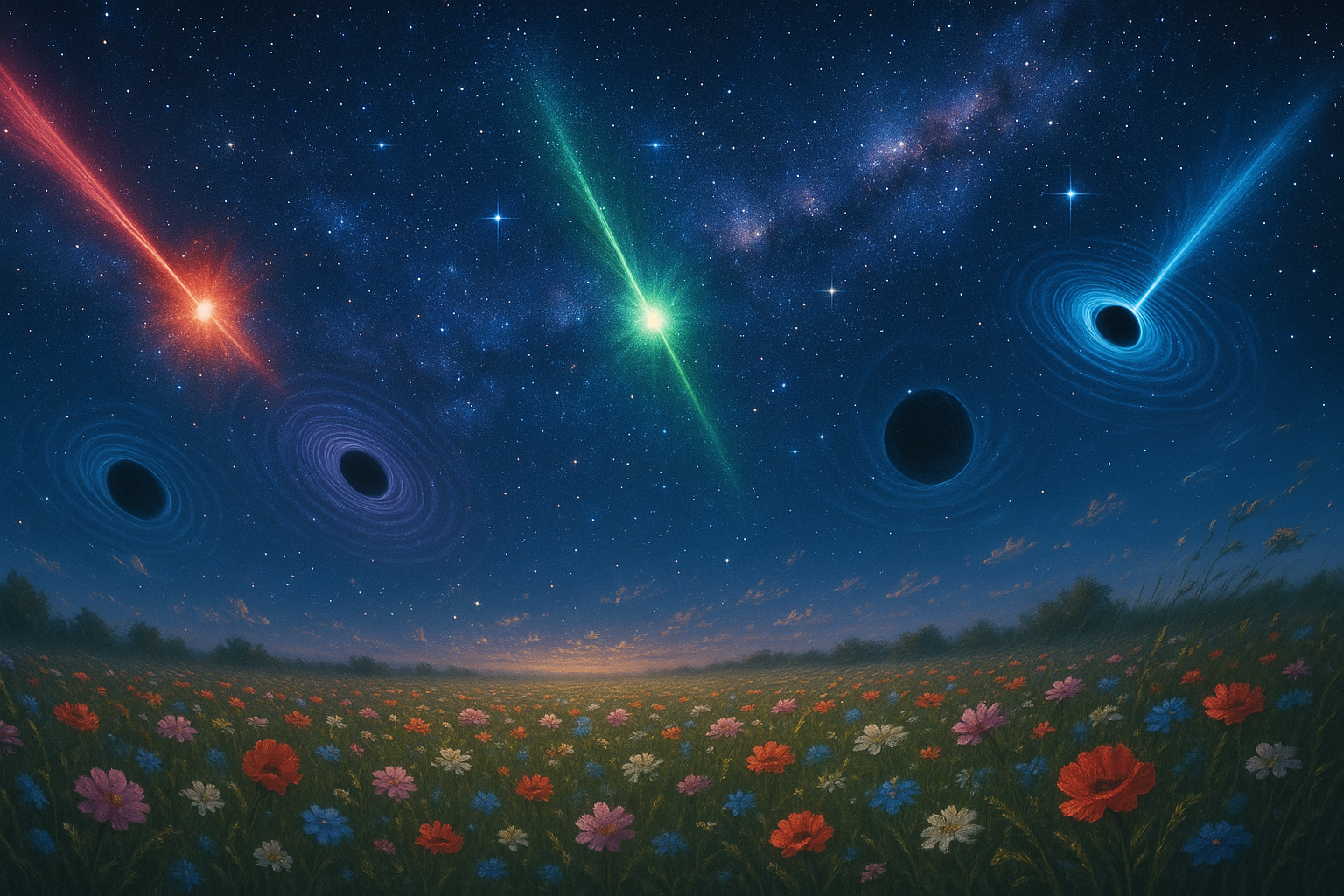
Have you ever wondered what music the stars play? As we revel in the beauty of May 2026, with flowers blooming and birds chirping, let’s talk about a melodious phenomenon—cosmic frequencies! It’s like the universe is strumming its own guitar, plucking strings made of light and gravity.
In the past few decades, scientists have discovered that everything in the universe vibrates. Stars hum in different pitches, black holes produce haunting tones, and neutron stars send out rhythmic beats like the universe’s very own metronome. You might think, “Does the cosmos actually compose symphonies?” Well, not quite, but the sounds of the universe can be transformed into music by clever scientists who turn vibrations into audio waves. Imagine your favorite tunes but mixed with the harmonies of distant galaxies!
Take pulsars, the glittering lighthouses of the cosmos. As these neutron stars rotate, they emit beams of radiation that pulse, akin to a strobe light at a dance party, showcasing their unique rhythms. Each type of pulsar has its own distinctive ‘sound’ – some sing high-pitched while others rumble like an old rock band.
Now, let’s not forget about black holes. When two black holes spiral toward each other and collide, they produce ripples in spacetime known as gravitational waves, which are like the bass drops of the universe! Scientists at LIGO (Laser Interferometer Gravitational-Wave Observatory) have been honing in on these waves and translating them into ‘music’ we can hear. So, while they might not top the charts, the sound of colliding black holes certainly adds an epic soundtrack to our understanding of the cosmos.
And you know what’s truly fascinating? These cosmic melodies might just give us insights into the very fabric of our existence. As we explore this celestial symphony, we’re peeling back layers of mystery: learning about the formation of planets, the lifecycle of stars, and even the conditions that foster life.
So the next time you look up at the sparkling night sky, close your eyes and tune in. Who knows? You might just hear the universe singing back to you. Embrace the enchanting symphony of cosmic frequencies and remember that, like the flowers in full bloom this May, the universe is alive with vibration!
In the past few decades, scientists have discovered that everything in the universe vibrates. Stars hum in different pitches, black holes produce haunting tones, and neutron stars send out rhythmic beats like the universe’s very own metronome. You might think, “Does the cosmos actually compose symphonies?” Well, not quite, but the sounds of the universe can be transformed into music by clever scientists who turn vibrations into audio waves. Imagine your favorite tunes but mixed with the harmonies of distant galaxies!
Take pulsars, the glittering lighthouses of the cosmos. As these neutron stars rotate, they emit beams of radiation that pulse, akin to a strobe light at a dance party, showcasing their unique rhythms. Each type of pulsar has its own distinctive ‘sound’ – some sing high-pitched while others rumble like an old rock band.
Now, let’s not forget about black holes. When two black holes spiral toward each other and collide, they produce ripples in spacetime known as gravitational waves, which are like the bass drops of the universe! Scientists at LIGO (Laser Interferometer Gravitational-Wave Observatory) have been honing in on these waves and translating them into ‘music’ we can hear. So, while they might not top the charts, the sound of colliding black holes certainly adds an epic soundtrack to our understanding of the cosmos.
And you know what’s truly fascinating? These cosmic melodies might just give us insights into the very fabric of our existence. As we explore this celestial symphony, we’re peeling back layers of mystery: learning about the formation of planets, the lifecycle of stars, and even the conditions that foster life.
So the next time you look up at the sparkling night sky, close your eyes and tune in. Who knows? You might just hear the universe singing back to you. Embrace the enchanting symphony of cosmic frequencies and remember that, like the flowers in full bloom this May, the universe is alive with vibration!