The Cosmic Symphony: Harmonizing the Universe's Frequencies
Cosmology & Universe
Astrology & Mythology
Loading image...
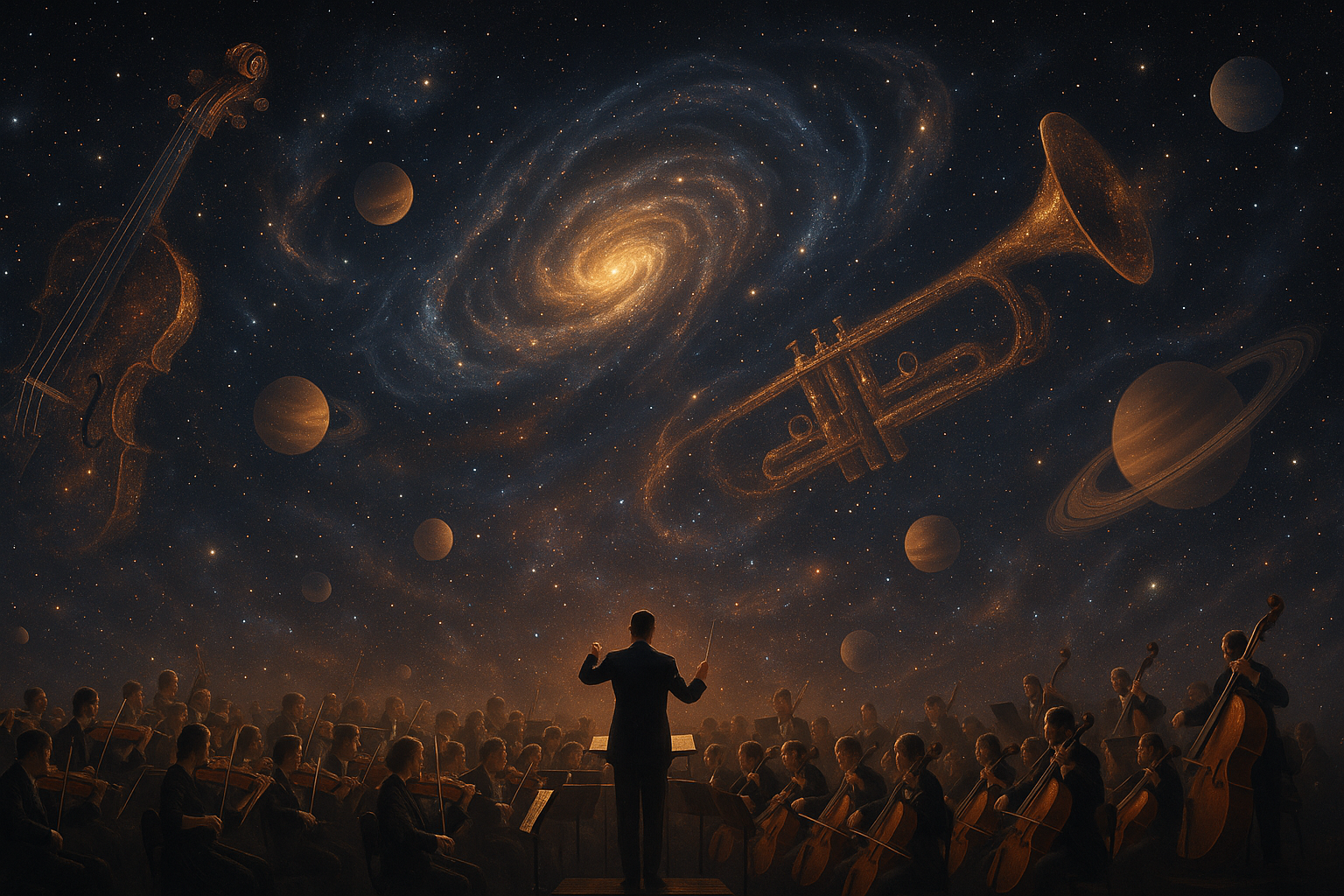
As the New Year rolls into full swing, it’s time to tune our ears to the sweet symphonies of the cosmos! Picture this: the universe is one grand orchestra, with celestial bodies playing their notes across the vast expanse of space. The stars twinkle like violins, while galaxies swirl and sway like dancers in perfect harmony. But what if I told you that the cosmos has its very own soundtrack, composed of vibrations and frequencies that ripple through the fabric of reality? The science of astrophysics teaches us that every star has its pitch, and these sounds can help us learn about their properties and behaviors. Imagine if we could sit in a galactic concert hall and experience a cosmic jam session—supernovae providing the percussion, pulsars contributing defined beats, and black holes creating deep bass lines that resonate through time and space!
In this blog post, we’ll explore how scientists measure these celestial sounds and what they tell us about the structure and evolution of our universe. From waves of gravitational energy to the haunting echoes left behind by the Big Bang, each frequency holds clues to our cosmic history. Just like a melody evolves over time, our understanding of the universe's symphony continues to deepen, revealing new harmonies and complexities.
Now, why should you care about the universe’s music? Well, think of it as your personal soundtrack to life’s mysteries! As you gaze at the shimmering stars in the January sky, remember they might just be singing a beautiful aria—if only we could hear it. So grab your metaphorical ear trumpet, and let’s delve into how different astronomical phenomena produce sounds that enrich our knowledge and ignite our imagination! After all, the universe's songbook is vast, and the performance is always ongoing. Who knows, maybe by the end of this reading, you'll have a new appreciation for those twinkling stars—our cosmic musicians giving a nod to the new adventures that await us in 2026!
In this blog post, we’ll explore how scientists measure these celestial sounds and what they tell us about the structure and evolution of our universe. From waves of gravitational energy to the haunting echoes left behind by the Big Bang, each frequency holds clues to our cosmic history. Just like a melody evolves over time, our understanding of the universe's symphony continues to deepen, revealing new harmonies and complexities.
Now, why should you care about the universe’s music? Well, think of it as your personal soundtrack to life’s mysteries! As you gaze at the shimmering stars in the January sky, remember they might just be singing a beautiful aria—if only we could hear it. So grab your metaphorical ear trumpet, and let’s delve into how different astronomical phenomena produce sounds that enrich our knowledge and ignite our imagination! After all, the universe's songbook is vast, and the performance is always ongoing. Who knows, maybe by the end of this reading, you'll have a new appreciation for those twinkling stars—our cosmic musicians giving a nod to the new adventures that await us in 2026!