Cosmic Timekeepers: The Art of Celestial Clocks
Astrophotography & Observational
Astronomy & Astrophysics
Loading image...
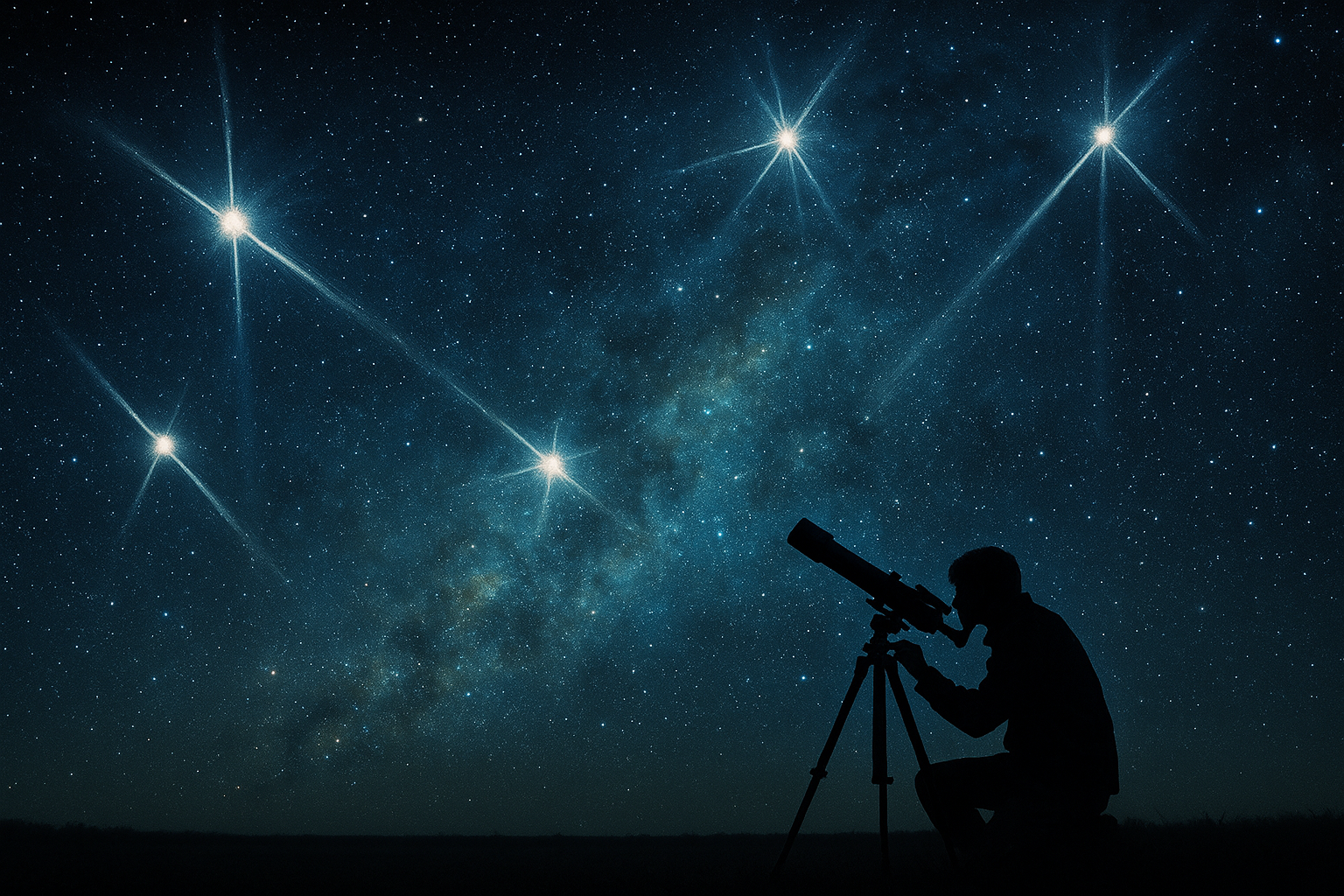
Have you ever wondered how the universe knows when it's time to throw a supernova party? As we orbit through the cosmic waltz in April 2026, it's a great time to explore the fascinating role celestial objects play as timekeepers in our universe. From the spinning of pulsars to the slow dance of galaxies, cosmic clocks are everywhere, ticking away in the vast expanse of space.
Let’s start with pulsars – the universe’s very own metronomes. These highly magnetized neutron stars spin at incredible speeds, emitting beams of radiation that sweep across space. It’s like they’re waving to us, trying to synchronize our watches as we get lost in the infinite night sky. Their precision is astonishing; some can keep time to within a billionth of a second! If timekeeping were a concert, pulsars would surely be the conductors, ensuring the symphony of the cosmos never misses a beat.
Then there’s the legendary Hubble Space Telescope, which also serves as a cosmic clock. By observing the light from distant galaxies, Hubble measures their redshift, helping astronomers understand the expansion of the universe - a kind of time dilation on a grand scale! It's akin to a cosmic time capsule, revealing how the universe has changed over billions of years. Imagine using a telescope to look back not just into space, but also into time itself, uncovering the history of the cosmos one light year at a time.
And let’s not forget the ultimate cosmic clock: the cosmic microwave background radiation (CMB). This faint glow is the afterglow of the Big Bang, spreading throughout our universe like an ancient photograph capturing the first moments of cosmic creation. Analyzing the CMB helps scientists determine the age of the universe, giving us context for our very existence in this vast celestial playground.
So, the next time you're stargazing on a clear April night, remember that the stars above are more than just bright lights; they're the universe's timekeepers, beckoning us to wonder and marvel at the intricate dance of time and space. It’s a delicate balance, much like trying to juggle time zones during a long flight, but who doesn’t love a challenge?
Let’s start with pulsars – the universe’s very own metronomes. These highly magnetized neutron stars spin at incredible speeds, emitting beams of radiation that sweep across space. It’s like they’re waving to us, trying to synchronize our watches as we get lost in the infinite night sky. Their precision is astonishing; some can keep time to within a billionth of a second! If timekeeping were a concert, pulsars would surely be the conductors, ensuring the symphony of the cosmos never misses a beat.
Then there’s the legendary Hubble Space Telescope, which also serves as a cosmic clock. By observing the light from distant galaxies, Hubble measures their redshift, helping astronomers understand the expansion of the universe - a kind of time dilation on a grand scale! It's akin to a cosmic time capsule, revealing how the universe has changed over billions of years. Imagine using a telescope to look back not just into space, but also into time itself, uncovering the history of the cosmos one light year at a time.
And let’s not forget the ultimate cosmic clock: the cosmic microwave background radiation (CMB). This faint glow is the afterglow of the Big Bang, spreading throughout our universe like an ancient photograph capturing the first moments of cosmic creation. Analyzing the CMB helps scientists determine the age of the universe, giving us context for our very existence in this vast celestial playground.
So, the next time you're stargazing on a clear April night, remember that the stars above are more than just bright lights; they're the universe's timekeepers, beckoning us to wonder and marvel at the intricate dance of time and space. It’s a delicate balance, much like trying to juggle time zones during a long flight, but who doesn’t love a challenge?