Beyond the Event Horizon: Peeking into the Secrets of Black Holes
Astronomy & Astrophysics
Cosmology & Universe
Loading image...
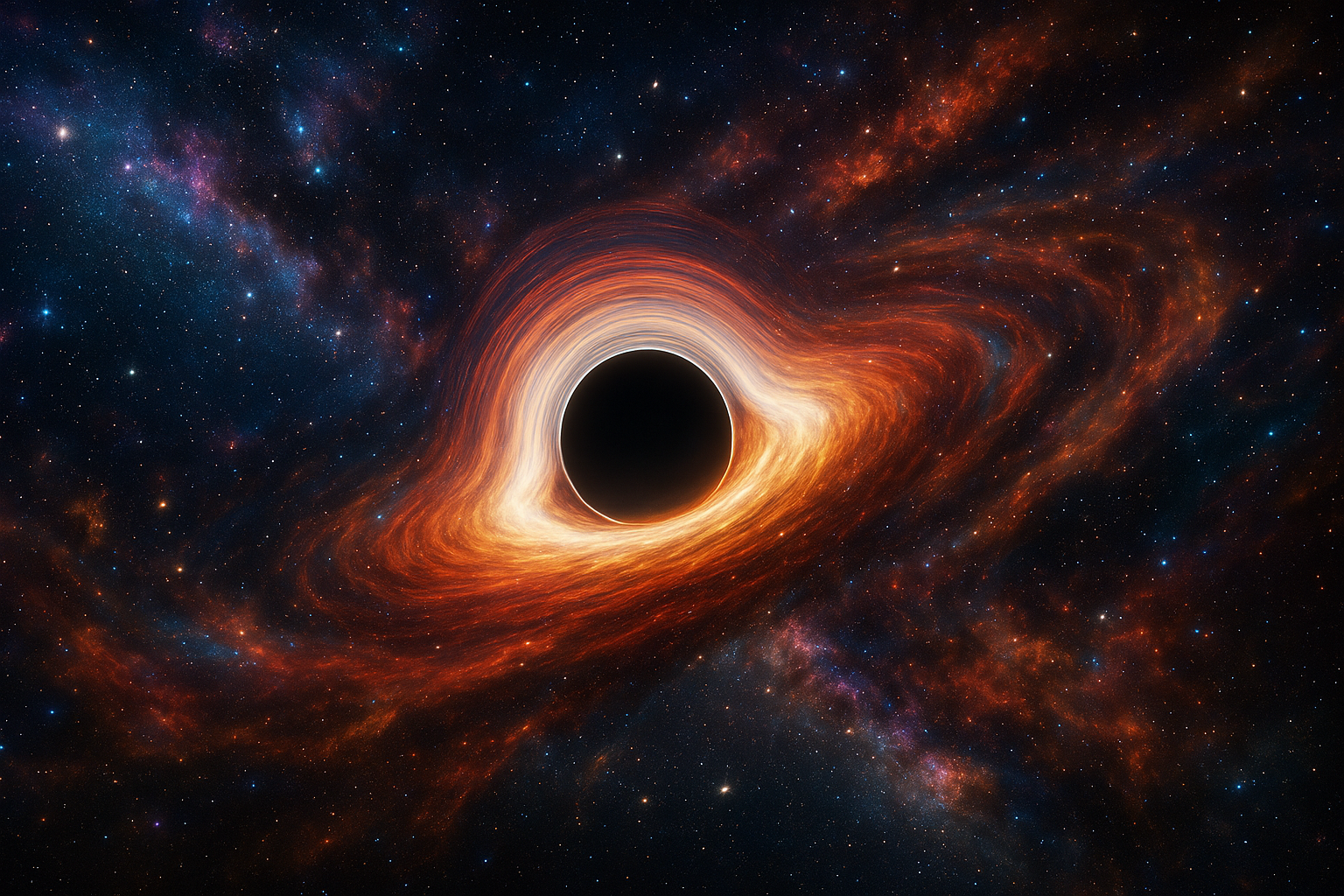
As we drift into October 2026, the universe beckons us to unravel the mysteries lurking just beyond the event horizon of black holes—those enigmatic cosmic predators with a gravitational pull so strong that not even light can escape their grasp. Think of a black hole as the universe's ultimate vacuum cleaner, but instead of sucking up crumbs, it devours everything in its vicinity, including stars, gas, and even time itself. So, what happens once you cross that point of no return? Well, dear readers, the answer is as elusive as a cat video on the internet: we just don’t know. But let’s explore this cosmic enigma with a playful twist!
Imagine standing at the edge of a black hole, where the laws of physics seem to take a holiday. You’re observing your surroundings as your watch ticks away at a snail’s pace—while the rest of the universe moves on like a busy highway. Time dilation, you ask? Absolutely! In this respect, black holes are like that party host who never allows guests to leave. And if you thought dinner parties could get awkward, imagine being in a scenario where all your friends are flattened into spaghetti by the immense gravitational forces—known as spaghettification. Talk about an uncomfortable experience!
The suspense surrounding black holes has kept astronomers on their toes, particularly with the emergence of gravitational waves, which are ripples in spacetime created when two black holes collide. Picture a cosmic dance-off between two heavyweights, creating synchronized waves that echo throughout the fabric of the universe! Just this past month, researchers were elated to detect one such wave, shedding light on how often these galactic tangoes occur and, most importantly, the secrets they uncover about the nature of space itself.
And then there's Hawking radiation, a phenomenon that sounds like a quirky episode from a sci-fi show. Proposed by the legendary physicist Stephen Hawking, this concept implies that black holes can emit radiation due to quantum effects near the event horizon. It’s as if black holes have a hidden agenda: they consume, but they also give—albeit in minuscule amounts, just enough to keep our curiosity piqued.
As we gaze into the vastness of the cosmos this October, let’s embrace the enigmatic nature of black holes and consider their profound implications on our understanding of the universe. There’s so much more than meets the eye, or in this case, the event horizon. So, if you ever find yourself near one of these cosmic vacuum cleaners, remember to pack your sense of adventure—and perhaps some spaghetti!
Imagine standing at the edge of a black hole, where the laws of physics seem to take a holiday. You’re observing your surroundings as your watch ticks away at a snail’s pace—while the rest of the universe moves on like a busy highway. Time dilation, you ask? Absolutely! In this respect, black holes are like that party host who never allows guests to leave. And if you thought dinner parties could get awkward, imagine being in a scenario where all your friends are flattened into spaghetti by the immense gravitational forces—known as spaghettification. Talk about an uncomfortable experience!
The suspense surrounding black holes has kept astronomers on their toes, particularly with the emergence of gravitational waves, which are ripples in spacetime created when two black holes collide. Picture a cosmic dance-off between two heavyweights, creating synchronized waves that echo throughout the fabric of the universe! Just this past month, researchers were elated to detect one such wave, shedding light on how often these galactic tangoes occur and, most importantly, the secrets they uncover about the nature of space itself.
And then there's Hawking radiation, a phenomenon that sounds like a quirky episode from a sci-fi show. Proposed by the legendary physicist Stephen Hawking, this concept implies that black holes can emit radiation due to quantum effects near the event horizon. It’s as if black holes have a hidden agenda: they consume, but they also give—albeit in minuscule amounts, just enough to keep our curiosity piqued.
As we gaze into the vastness of the cosmos this October, let’s embrace the enigmatic nature of black holes and consider their profound implications on our understanding of the universe. There’s so much more than meets the eye, or in this case, the event horizon. So, if you ever find yourself near one of these cosmic vacuum cleaners, remember to pack your sense of adventure—and perhaps some spaghetti!